
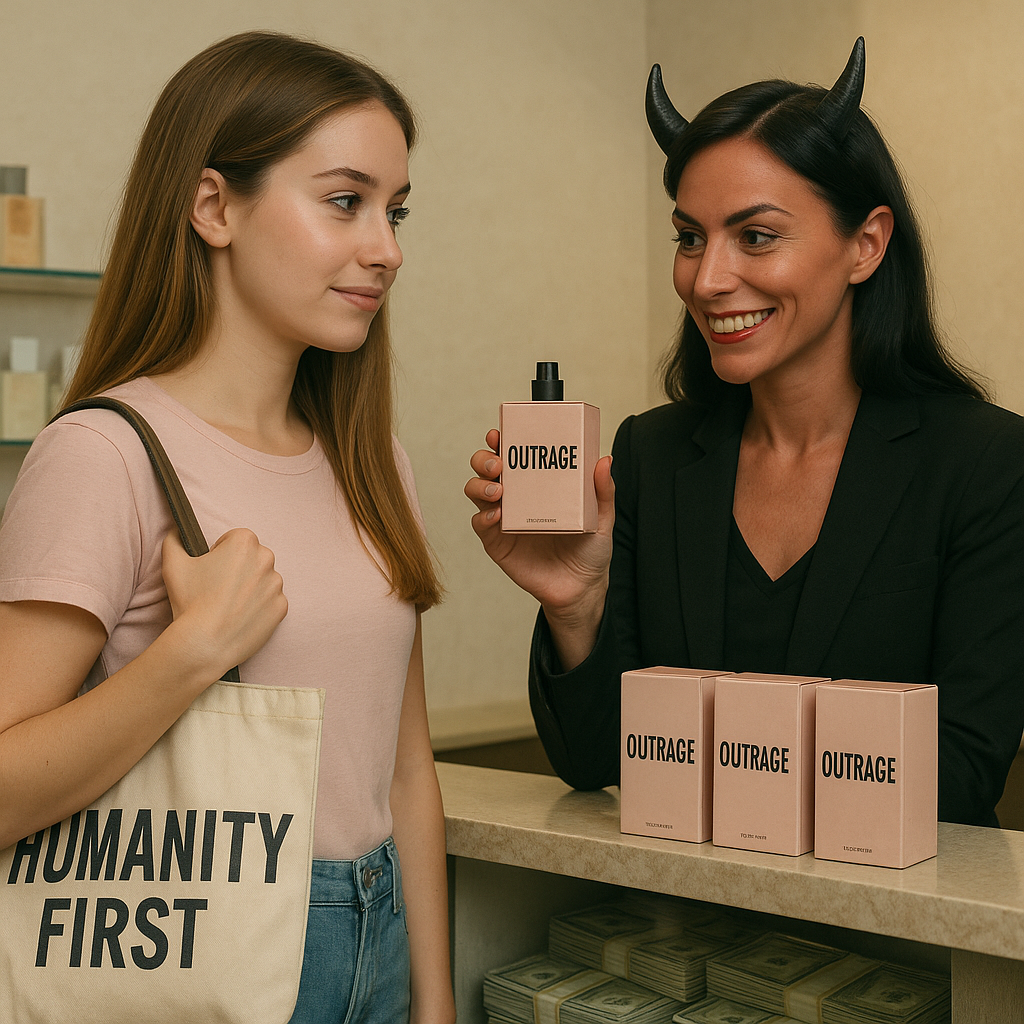


Modern dissent: streamed, branded, and conveniently auto-billed to your Venmo account.
It started with rainbow logos — the kind of branding that smells like vanilla empathy and costs $39.99 in a reusable tote. Somewhere around 2015, the marketing departments of America woke up, wiped the drool off their ergonomic keyboards, and realized that morality could be monetized. After all, who doesn’t want a deodorant that fights sweat and systemic racism?
Once the smell of virtue filled the air, it was only a matter of time before the big boys got in on the act.
Nike, Bank of America, ExxonMobil — the usual suspects — launched moral pilgrimages stitched together with new fonts and better lighting. Pride Month? Slap a rainbow on the logo. And just like that, human rights became a seasonal SKU. Earth Day? Post a bonsai tree meme in front of a landfill and caption it ‘sustainability.’ Black Lives Matter? Workshop a tagline, post a black square, and pray the interns know how to spell ‘solidarity.’
Corporate virtue-signaling is the art of taking real human agony, running it through a focus group, and selling it back to the public like a scented candle. It’s not resistance; it’s image control with higher contrast and a smoother filter. The same companies lobbying to gut labor protections will post TikToks about “building community.” The same tech giants strip-mining your privacy will produce heartfelt Super Bowl ads about “connection.”
But never mistake posture for principle. In the safe, hermetically sealed world of the C-suite, courage means endorsing whatever cause polls at 60% approval among suburban 28-year-olds with subscription yoga pants. It means “taking a stand” — but only if the backlash can be quarantined to a few angry tweets from retired colonels and NASCAR dads. Hand them a catchphrase and a clearance rack, and they’ll leap into the conscience costume.
Take H&M, the fast-fashion giant whose supply chain still functions like a Dickens novel rewritten by OSHA lawyers. The ad campaign featured models of all sizes, colors, and pronouns, posing solemnly while slogans like “Freedom Fits All” floated behind them — wearing cotton stitched by children in countries not exactly famous for their glowing labor rights records: namely, China, Bangladesh, and Turkey — so executives could tweet about empowerment. Ethical fashion, apparently, now arrives courtesy of a 10-year-old threading slogans in a windowless room to help Westerners announce their compassion in limited edition crop tops.
Or take McDonald’s — a fast-food empire that unveiled eco-friendly packaging to “protect the planet,” then celebrated by torching another patch of rainforest for cattle grazing. The wrappers got greener, the beef got redder, and the lungs of the Amazon got a little blacker. All part of a balanced, planet-conscious breakfast.
And then there’s Meta, which, fresh off a buffet of privacy scandals and content moderation failures, launched its “Metaverse for Mental Health” initiative. The campaign showcased digital safe spaces and avatar therapy sessions — a virtual balm from the company whose algorithmic sewage pipe helped mainstream paranoia, body dysmorphia, and cult recruitment. This is the platform whose engagement models are built to reward conflict, outrage, and emotional instability — an industrial-scale tension machine posing as your neighborhood therapist. Because when the fire’s spreading, why not sell marshmallows?
Welcome to the new activism: all optics, no oxygen. A ritual of nodding and buying, where gestures get louder as substance gets thinner. It asks nothing of the consumer except a standing ovation and nothing of the corporation except plausible deniability.
Feel outraged? Buy the hoodie. Haunted by climate collapse? Sink into a cruelty-free bath bomb called “Meltdown” and let the lavender handle your panic. Resistance is now a subscription service, and your conscience ships free with orders over $50.
In the end, corporate activism isn’t about conscience or consequence — it’s about continuity. Keep the anger profitable, the catchphrases biodegradable, and the ethics low-maintenance. The real world burns, but the boardrooms stay frosty — cooled by oscillating fans and non-disclosure agreements.
Revolution’s on sale. Just don’t forget to enter the promo code at checkout.