
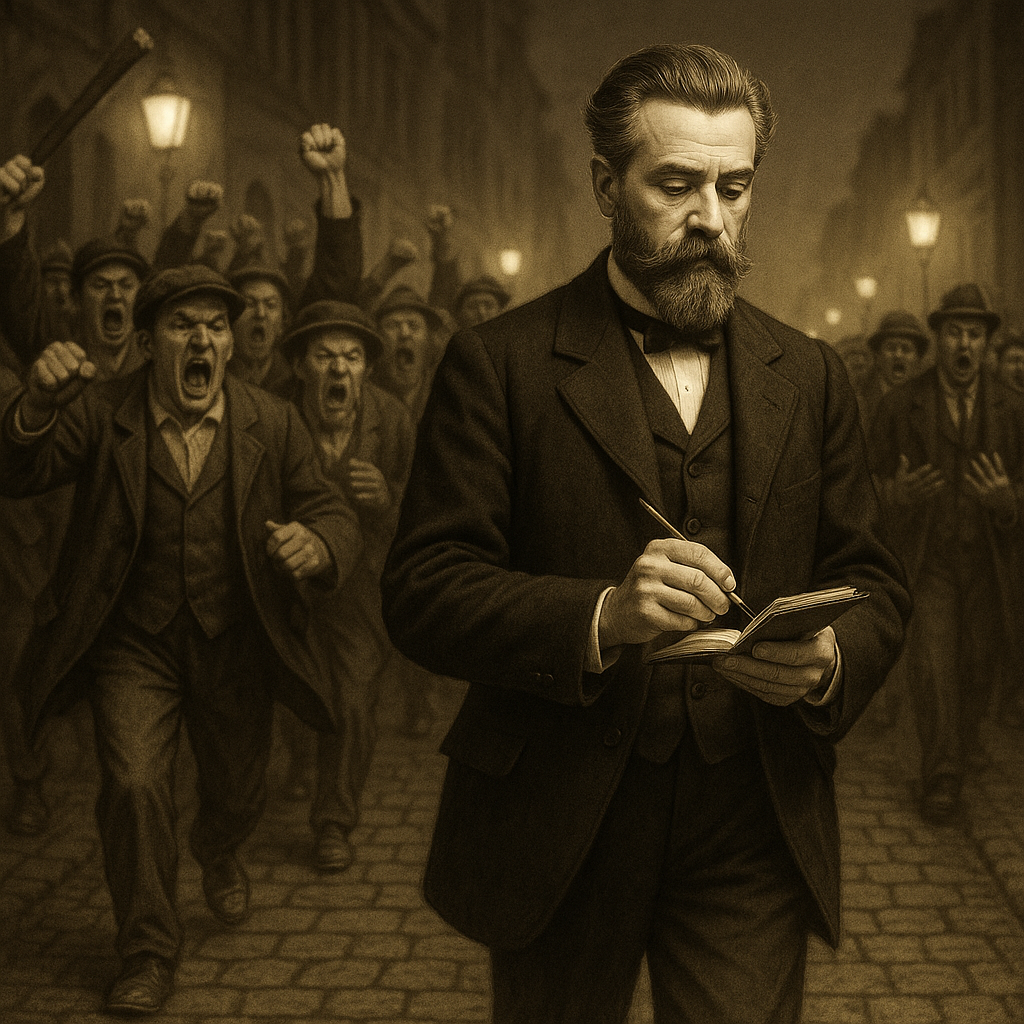


In 1895, Gustave Le Bon—a French polymath, amateur psychologist, and professional pessimist—published The Crowd: A Study of the Popular Mind. He wasn’t the first to notice that people behave differently in groups. But he was among the first to map the transformation: how individuals, once absorbed into a collective, become reactive and compliant, surrendering reason for raw impulse.
What Le Bon described on paper now plays out through screens. Twitter threads and Facebook fights have replaced the town square. The crowd he feared never dissolved—it dispersed into code. What once surged in public squares now pulses through platforms—no less volatile, only more efficient.
Le Bon outlined three traits that define collective behavior: anonymity, contagion, and suggestibility. The internet, naturally, has all three hardwired. Behind handles like “Patriot1776” or “WokeAvenger,” users shed inhibition and become digital zealots. Unburdened by identity and stripped of restraint, they leap to purge wrongthink and enforce ideological purity by reflex. They don’t gather—they deploy.
Contagion, in Le Bon’s terms, is the wildfire of collective behavior. One emotional spark can ignite mass hysteria. A 2018 MIT study confirmed this: false news travels six times faster on Twitter than truth. Why? Because lies stir reaction—the more shocking, the faster they spread. Online collectives aren’t informed—they’re triggered. Outrage spreads, clarity collapses, and nuance is smothered beneath emotional spectacle and clickbait heat.
The next lever Le Bon identified was suggestibility: the hive’s hunger for simple, repeatable dogma. According to Pew Research (2020), over half of U.S. adults get their news primarily from social media. Not surprisingly, these platforms reward the emotional over the rational. The result? Mantras like “Silence is violence” or “Stop the steal” collapse nuance into ideological scripts. The crowd doesn’t want dialogue—it wants doctrine: quotable taglines packaged as truth and built for velocity. And once it’s moving, it wants a target. Like a rage-blind GPS, it’ll reroute through whatever moral crisis is trending—just as long as someone else is to blame.
Mobs aren’t partisan—they form wherever rage eclipses reason. But if we’re measuring cultural volume, political reach, and emotional volatility, one faction clearly leads: a progressive offshoot of liberalism, louder, sharper, and more performative than any of its rivals.
They claim to be building the future—but operate with the fervor of inquisitors, not architects. The slogans preach inclusion, but the method is purging. Behind the big tent optics is a rigid moral order that markets virtue, but enforces conformity. One moment they’re condemning oppression from a smartphone, the next they’re performing guilt theater for sins long buried by time. When caption activism hits the real world—like flooding cities with unvetted migrants while defunding the police—the result isn’t reform; it’s a cascade of unintended outcomes. And instead of course correction when theory and policy fail, we get escalation. The slogans multiply, the blame shifts, and the consequences get buried under moral posturing and empty public declarations. Because admitting utopias don’t scale would mean admitting failure—and that’s off-brand.
Reflection is replaced by pageantry, wherein public activism mutates into a form theater—inflated for optics, and staged for affirmation. A 2020 Nature Communications study found that moral outrage on social media is more often driven by social incentives than conviction. Think moral tourism: visit the spectacle, post your selfie, and move on. A trending flag, an emoji bio, a cause-colored graphic—none of these are revolutions. They’re signals: curated and safe, designed to showcase affiliation, not conviction. They say, ‘I’m one of the good ones.’ But self-display isn’t agency, and performance isn’t progress. It’s like wearing a “world peace” T-shirt to a knife fight and thinking you’ve disarmed the enemy.
A 2017 Psychological Science study backs this up, showing that chronic moral grandstanders tend to exhibit higher levels of narcissism and dominance-seeking behavior. That’s why yesterday’s ally can become today’s ideological prosecutor—their devotion isn’t to principle, it’s to position—preferably high ground from which they can shout you down. And in a crowd, there’s no faster way to gain status than to publicly burn a heretic.
But ideological mobs don’t run the show—they’re tools. Whether it’s PAC-funded outrage, click farms abroad, or cable news monetizing division, today’s mob isn’t spontaneous—it’s engineered.
Le Bon warned that collectives are fertile ground for manipulation—feed them emotionally loaded ideas with enough repetition, and they become gospel. “The masses,” he wrote, “are only too ready to accept what is repeated to them with force and persistence.” Today’s political class has weaponized that insight. Pew data shows polarization at a 30-year high, driven not by debate but design. Politicians and pundits don’t inform—they choreograph. Astroturfing is now routine: operatives posing as citizens, staging outrage, scripting conflict for the cameras. What looks like grassroots is often just theater in cheap clothes. But once the mob is lit, it doesn’t deliberate. It convicts. What moves people isn’t evidence—it’s blood on the gavel.
Groupthink isn’t just political—it’s personal. Herds form when people feel hollow. Loneliness is perfect kindling. All it takes is a spark.
Mass movements aren’t built on politics—they’re built on need. For the disoriented, belief is ballast. As Eric Hoffer observed in The True Believer, they don’t attract the empowered—they attract the unmoored. Hoffer noted that true believers can’t tolerate ambiguity and often lash out over the faintest dissent—sometimes at acquaintances they haven’t spoken to in years. A 2022 study by the American Psychological Association found that 41% of Americans reported strained relationships due to political disputes—many with people they barely know. This isn’t activism. It’s emotional outsourcing—therapy by hashtag, billed to your conscience.
The gut punch? Most of these digital warriors aren’t leading a cause—they’re being led. Between meme-bombing comment sections, they’re following scripts they didn’t write, for causes they barely understand. A 2021 Stanford Internet Observatory report exposed how bots and coordination networks steer online discourse with surgical precision. Now AI joins in—triggering outrage in real time, curated for conflict and packaged as principle. And yet, users think they’re independent actors—fighting injustice, defending truth. In reality, most are just echo chambers running on autopilot, confusing noise for will. They’re not resisting the machine—they are the machine, just with more Spotify playlists and auto-corrected zealotry.
The modern mob is digital, performative, and always on standby. It doesn’t need pitchforks—it has pixels. It reacts. Its goal isn’t to uplift. It’s to dominate. Not to challenge power, but to acquire or hold it.
Progressives call themselves forward-thinking, but their worldview is rooted in the past and recycled grievances. Contrary to claims of tolerance and enlightenment—they demonstrably punish dissent, exile the impure, and execute ritual justice. Unlike the liberalism from which it sprang, progressivism centers on identity and victimhood—not to liberate, but to destabilize and subdue. It frames the world in binary terms—oppressors and oppressed—then demands power in the name of redress.
What does this all mean? Politicians, social media trolls, and progressives alike love to cosplay as revolutionaries, but what they’re staging is less revolution than rerun—only noisier and dressed in catch phrases and meme fonts.
One upside to the mob invading your timeline? It exposes the unhinged in real time—an endless PSA rendered in emojis, outrage, and algorithmic casualties. You learn to spot the crazy.
Le Bon was right. The crowd never left. It just learned to log on.
📚 Bibliography
-
- Le Bon, Gustave. The Crowd: A Study of the Popular Mind. 1895.
-
- Vosoughi, Soroush, Roy, Deb, and Aral, Sinan. “The Spread of True and False News Online.” Science, vol. 359, no. 6380, 2018.
- Pew Research Center. “Americans Are Wary of the Role Social Media Sites Play in Delivering the News.” 2020.
-
- Pew Research Center. “Political Polarization in the American Public.” 2022.
-
- Graso, M., Reynolds, T., and Reynolds, K. Psychological Science, 2017.
-
- Brady, W. J., Wills, J. A., et al. “Emotion Shapes the Diffusion of Moralized Content in Social Networks.” Nature Communications, 2020.
- Stanford Internet Observatory. Coordinated Inauthentic Behavior Reports. 2021.
-
- Hoffer, Eric. The True Believer: Thoughts on the Nature of Mass Movements. 1951.hPoliticians, acquire