
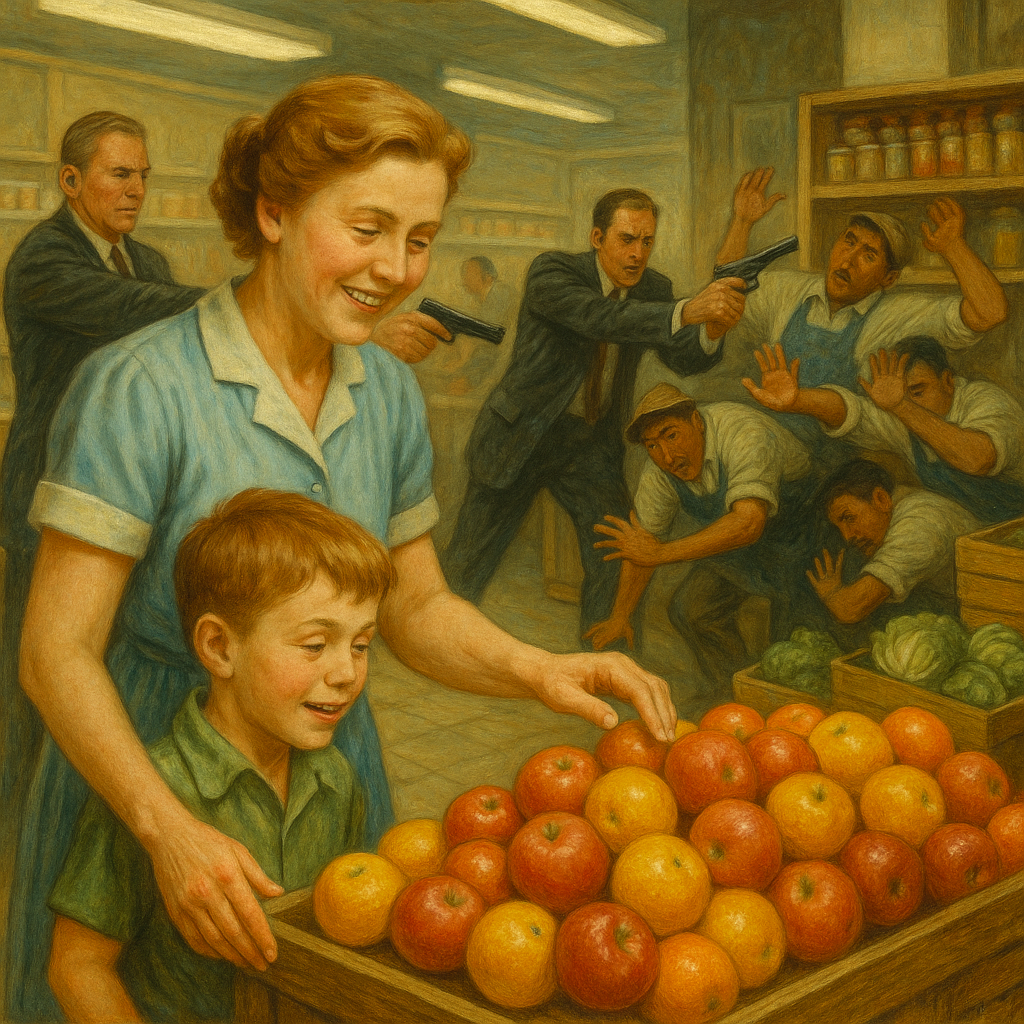


In the blood-soaked drama of U.S. foreign policy, the first act rarely changes: defy our corporations, and the visitors arrive with smiles, signatures, and silencers.
After World War II, American foreign policy turned its gaze southward. Europe had been divided, Asia was burning, and Latin America—poor, restless, and resource-rich—offered a new arena for the old drama of capital versus reform. Washington didn’t see neighbors. It saw vulnerabilities. Over the decades that followed, those vulnerabilities became assignments.
By the late 20th century, in an effort to “spread democracy,” the CIA roamed Latin America like a custodian with kill orders—cleaning up leftists, reformers, and the occasional priest. It was just Act Two in a familiar production: a populist wanders off-script, and the stagehands show up armed and uncredited. It didn’t matter who vanished, as long as breakfast hit the table in Ohio and dividends cleared in D.C.
The curtain rose early in Brazil, where democracy showed its first cracks under the weight of Washington’s interests. In 1964, President João Goulart leaned slightly left—advocating labor protections for transit workers and industrial unions, expanding public education to combat illiteracy, and nationalizing foreign-owned oil refineries. That was his crime: he sought to empower the working class and reduce foreign economic dominance.
Nothing rattles Washington quite like a bus driver with a pension.
The response was swift, practiced, and as routine as a jailhouse beating. The military, with a green light from the U.S., shoved Goulart aside and installed two decades of dictatorship—efficient, orderly, and brutal enough to pass for economic policy. Labor leaders fell off the map. Some were “disappeared” in daylight—dragged from union halls and tossed into the Atlantic. The economy was “reformed”—in the same way a morgue applies rouge: cosmetic, cold, and meant to ease the viewing.
Nowhere was the staging more meticulous than in Chile. In 1970, Salvador Allende won a democratic election on a platform of land reform and nationalization. And that alone put a target on his back. Nixon ordered the CIA to “make the economy scream”—and scream it did —into the arms of General Augusto Pinochet, who governed with cattle prods, mass graves, and the calm efficiency of a man balancing a spreadsheet with a bayonet. The trucks rolled in. The radios went dead. Then the real numbers started to fall—bodies, not ballots. The whole thing was funded, orchestrated, and dry-cleaned by the United States. Apparently, democracy was acceptable—until it voted the wrong way.
The pattern rolled on—Bolivia, Guatemala, same blood, different borders. Idealists were branded as Marxists, unionists tagged as insurgents, and anyone pushing land rights found themselves staring down a U.S.-trained militia with a business plan. Because nothing says national security like a peasant with acreage. In Bolivia, the CIA funneled cash to opposition groups and greased the skids for coups that gutted labor movements—teachers, miners, nurses arrested or executed while their unions were declared threats to national security. It wasn’t about ideology. It was about ownership. This wasn’t foreign policy. It was supply-chain enforcement with a kill list.
In Guatemala, the process was even cleaner. In 1954, the democratically elected president, Jacobo Árbenz, made the mistake of redistributing unused land owned by United Fruit. The company picked up the phone. Washington answered. The CIA packed a bag. Árbenz was gone by summer. What followed was a decades-long bloodletting sold as reform: mass arrests, scorched villages, and thousands of Mayan peasants executed as “insurgents.” The brochures said stability. The mass graves didn’t qualify for comment.
These weren’t isolated incidents. They were coordinated plays on a global chessboard where food wasn’t sustenance—it was leverage. Cheap imports weren’t trade policy; they were trophies of covert conquest. Keep prices low, keep the ports humming, and if a few million campesinos had to vanish into unmarked earth so suburban shoppers could buy fruit without tasting the blood behind it, that was just logistics. Nothing says “free market” like a firing squad with U.S. funding and a shipping deadline.
Today, Americans flinch at the thought of delayed shipments like it’s a civil rights issue—melting down over oat milk that hasn’t arrived on schedule. We’ve built entire neuroses around waiting 72 hours for a toaster stitched together in some fluorescent hell by hands we’ll never see. But supply anxiety isn’t new. We just cleaned it up. Once, we didn’t wonder where our food or goods came from—because men with guns made sure we didn’t have to. Now we outsource the labor and the body count.
After all, nothing cleans the conscience like subcontracting the violence.
As we flood Ukraine with weapons and speeches, let’s not pretend we’ve turned a moral corner. Europe’s breadbasket is just the latest field in a long, grim harvest—grain, gas, and buried minerals traded under the banner of freedom. The slogans change. The contracts don’t. Silos, pipelines, weapons contracts, and mining rights—raw plunder, repackaged as principle. The language got cleaner; the motives didn’t.
If freedom arrives in Eastern Europe—it’ll wear a Shell logo and carry mineral rights.
📚 Bibliography
Blum, W. (2003). Killing hope: U.S. military and CIA interventions since World War II (Updated ed.). Zed Books.
Grandin, G. (2006). Empire’s workshop: Latin America, the United States, and the rise of the new imperialism. Henry Holt and Company.
Kinzer, S. (2006). Overthrow: America’s century of regime change from Hawaii to Iraq. Times Books.
LaFeber, W. (1993). Inevitable revolutions: The United States in Central America. W. W. Norton & Company.
Schlesinger, S., & Kinzer, S. (2005). Bitter fruit: The story of the American coup in Guatemala (2nd ed.). Harvard University Press.
U.S. Department of State. (1970–1976). Foreign relations of the United States (FRUS) [Volumes]. Office of the Historian.