
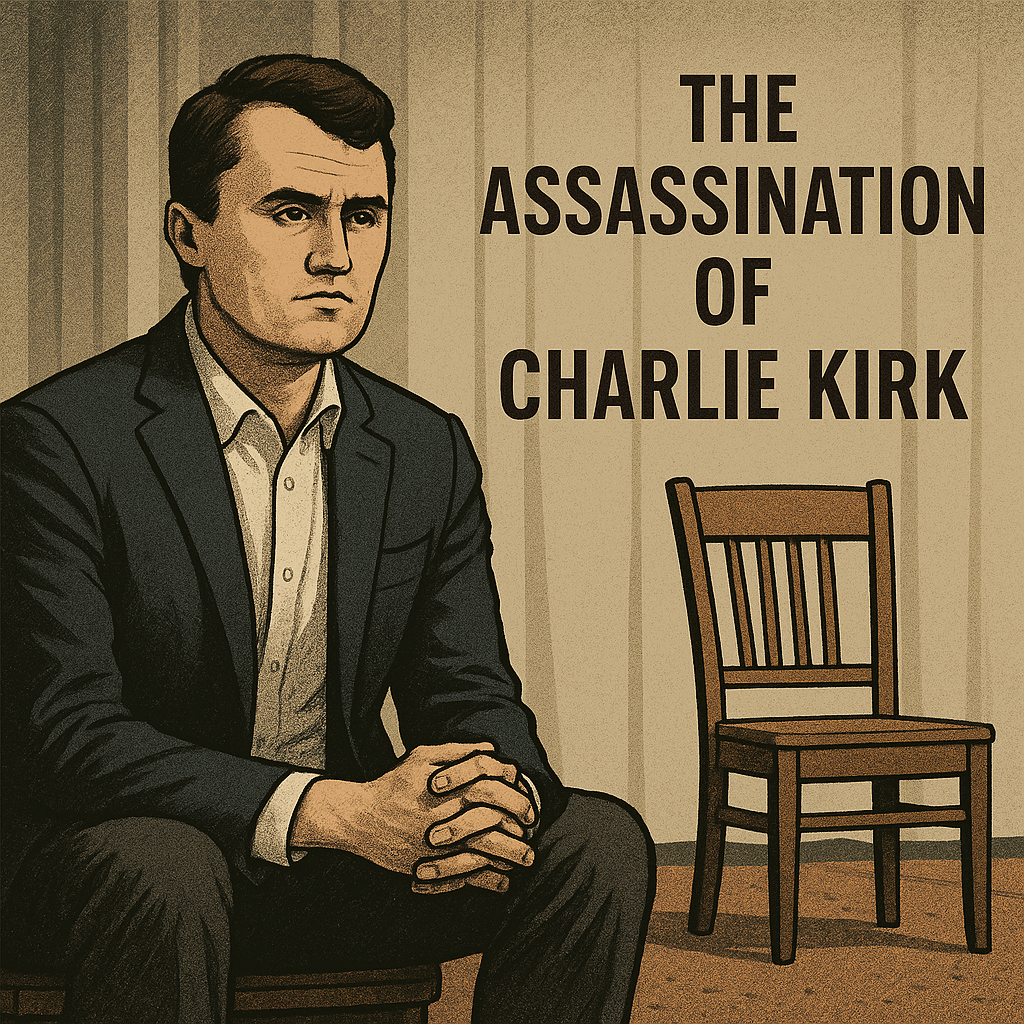


I didn’t pay much attention to Charlie Kirk when he was alive, I caught a few videos of him over the years, but Charlie’s youth and the audience he spent his time challenging, are not tailored to my viewing habits—I’m a boomer as my sons are fond of saying. And, while I didn’t agree with him on all matters, or like some of the things he said, I had a respect for Charlie’s methods and his willingness to challenge and be challenged. Charlie was clearly a voracious reader—even his critics would have to acknowledge that.
I’ve noticed over the last few days that most online posts and news stories on his murder seem to miss what I believe is the real story. That Charlie Kirk died with his proverbial boots on—not in war, not in power, but in the rhetorical thunderdome we now call America. A man walked into a public event and shot him. Why? Because he disagreed.
Not because Charlie harmed him. Not because Charlie silenced or harmed anyone. But because Charlie did the one thing that now gets you labeled dangerous: he asked people to explain themselves.
Charlie Kirk didn’t wield power, He didn’t write laws. He wasn’t staging coups or signing drone strike memos. He ran a conservative organization that booked college lectures, asked combative questions, and invited people to debate him in public. He confronted the ideas he opposed and gave their owners the mic to respond.
That’s supposed to be democracy’s drumbeat. Instead, it got him killed—let that sink in.
Another young man, Tyler Robinson, was so disturbed by Charlie’s views that he believed killing him was a more deserved response than engaging with his arguments. Rather than countering Charlie’s ideas with his own, Robinson acted on the entitled conviction that silencing him—permanently—was necessary for the greater good. Presumably, in his mind, Charlie posed such a threat to his worldview, and perhaps to the ideological grooming of future generations, that murder was an acceptable option.
Say what you want about Charlie Kirk, but he had the spine to walk into hostile rooms. He went to college campuses where security had to usher him through the back door, and he still faced the crowd. He asked people who hated him to defend their beliefs—and he listened. He didn’t hide behind anonymity or curated panels. He showed up. Publicly. Repeatedly.
Like all people, Charlie Kirk had faults, but cowardice wasn’t one of them.
Was he smug? Maybe. Sharp-elbowed? Probably. Did he offend people occasionally? Yes. But he stood up, spoke plainly, and expressed his views. He invited conflict of thought, not conflict of fists. He stepped into rooms full of people who wanted to see him humiliated and said, “Alright, let’s talk.”
And for that, he was shot.
The fact is: there is no equivalent to Charlie Kirk on either side of the political aisle—no one with a nationally organized, confrontational presence who would consistently and joyfully enter the lion’s den alone, armed only with his opinions and an open mic to say to the opposition, “We don’t agree. I have a position. What’s yours? Let’s discuss this.”
And now the lions are fed.
Charlie’s murder didn’t just happen—it was cultivated in our current culture. This divide we live in is not a byproduct. It’s a business model. Political media doesn’t run on clarity. It runs on combustion. The more you hate the other side, the longer you stay glued to your feed. No headlines said, “Father Killed for Hosting a Debate.” Instead, all sides parsed the shooting through the kaleidoscope of political branding.
I have two sons in their twenties, Charlie’s target demo—both more progressive than I am. Neither agreed with Charlie. But they understood what was lost: a man, yes—but also something larger. My sons are both good men and realize that civic trust and our collective social contract are broken. That disagreement should not be a death sentence. That dialogue, however combative, is supposed to be a part of the American deal.
Apparently, it’s not.
A look at social media tells the story of America: immediately following Charlie’s assassination, we got social media proclamations and ideological dissections. Some mourned. Some took it as a teachable moment. Others, however cleverly worded, or later retracted—justified the assassination, like his death was a moral invoice, finally paid. A few blue-check avatars even suggested this was “what happens when you platform hate,” as if inviting people to argue on stage is now a capital offense worthy of execution. There were flyers of hand-drawn cartoon images circulating on a college campus of Charlie gripping his neck with blood spurting out, with the caption “Debate This”.
What happened to Charlie was mob logic:
If he disagrees, he threatens me.
If he threatens me, he is not human.
If he is not human, then killing him is justice.
That’s not dissent. That’s ritualized dehumanization.
The simple truth is: Charlie Kirk talked. And that—just talking—was enough to make someone decide he no longer deserved to live.
A wife is now a widow. Children lost their father. And a nation that should have mourned or reflected instead pulled out its scorecards.
This isn’t just ideological rot. It’s best to call it what it is: moral and societal decay.
We don’t grieve anymore. We calculate. We don’t see people—we see political assets. Did they vote right? Speak our language? Belong to the correct camp? If not, their death and the value of their life become debatable.
Charlie Kirk is gone. His wife lost a partner, his parents lost a son. His kids will grow up watching videos of their father spar with strangers—only to learn one of them brought a gun. His family is irrecoverably changed, and so is the Robinson family—they also lost a son.
And for what? A difference of thought.
That’s how far we have fallen, that’s who we are now. A country where speaking to the opposition and saying things that someone doesn’t agree with can get you killed.
It can seem at times that the America we once knew is now just a collection of hashtags, headlines, and hollow people consuming their algorithmic preferences into mental illness. And in some ways, that is precisely who we are.
This week, an empty chair on a blood-stained college stage is the gruel. Don’t let that be our legacy … or Charlie’s.