
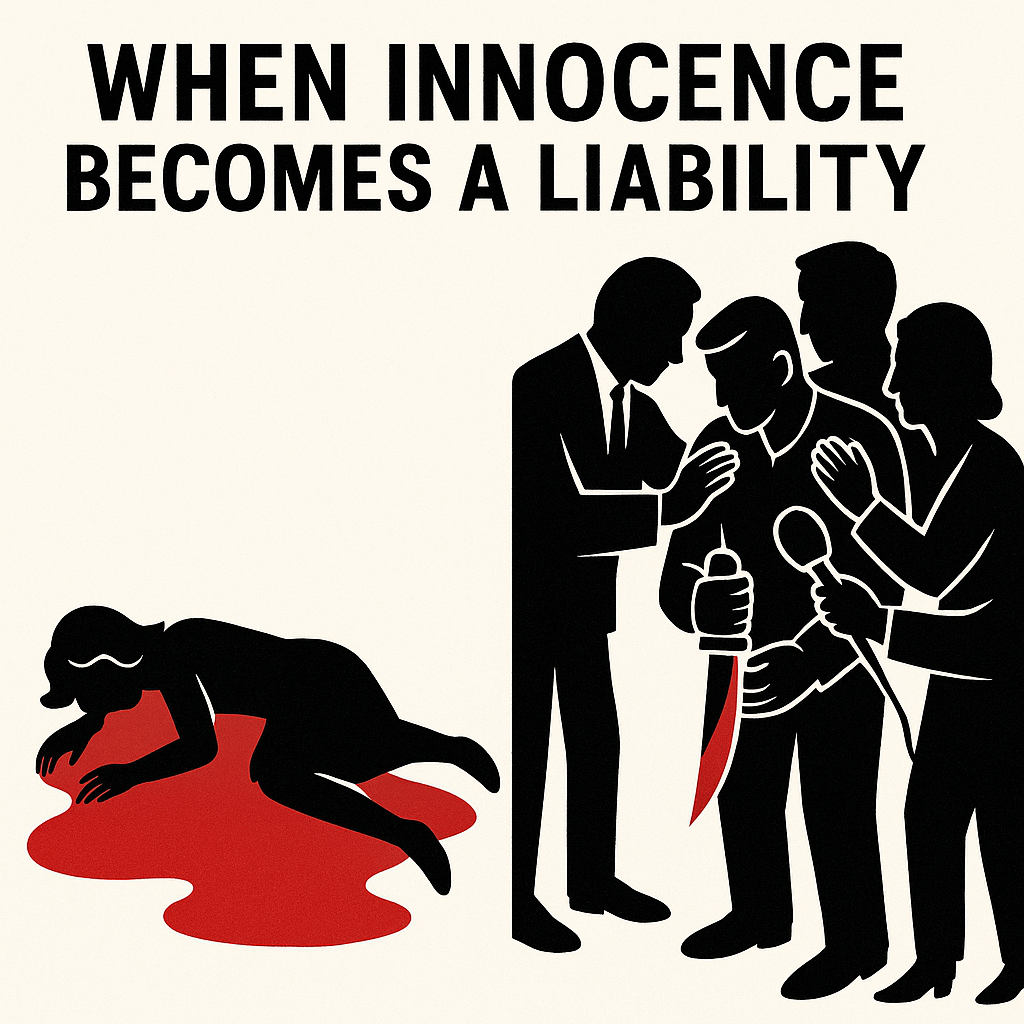


On August 22, 2025, Iryna Zarutska boarded a light-rail train in Charlotte, North Carolina. She was 23 years old, a Ukrainian refugee who had fled the Russian invasion and the wreckage of her hometown. Friends, family, and neighbors described her as disciplined and ambitious, someone who aspired to become a veterinary assistant and was studying English at a community college. She came to America to rebuild, in a country where daily life could be lived without the sounds of shelling and the sights of destruction and violence.
That illusion ended abruptly. A man seated behind her pulled a knife and stabbed her—three times, including once in the neck. As she collapsed to the floor, bleeding out on the train, the other passengers turned away. No one intervened. No one called out. Whether it was fear of her assailant or paralyzing indifference, no one offered aid as she died. In the video released to the public, you can see the shock register on her face—the dawning realization of her own impending death—and, around her, the apathy of those nearby. Most remained seated, eyes averted, as though witnessing a minor disturbance rather than a murder in progress.
Her killer, Decarlos Brown Jr., had been arrested 14 times. He had a documented history of mental illness and was out on bail at the time of the attack. His background, his traumas, his diagnosis became the focus for much of the media’s attention. Zarutska’s murder was obscured in the national narrative, minimized almost as soon as it was reported. Her killing was eclipsed in coverage by a more partisan spectacle—the assassination of political commentator Charlie Kirk. The nation debated motives, rhetoric, and ideological fallout, while the young woman stabbed to death on a Charlotte train slipped quietly to the margins, her life treated as incidental.
The decision to release Brown rested with Magistrate Judge Teresa Stokes, who had presided over one of his earlier arrests and approved his release. Stokes has well-documented ties to rehabilitation ventures—cofounding a Michigan nonprofit, linking with a Charlotte recovery center, and promoting sobriety-themed projects. While there is no record of personal or financial gain in Brown’s case, the pattern reveals a judicial approach where idealism shapes decision-making, and the prospect of public danger is an acceptable variable. Brown was arrested and released multiple times. Repeated attempts at rehabilitation may be noble in intent. But when ideals override risk calculus—when release becomes ritual—the result is not jurisprudence. It is social experimentation, with the public paying the cost.
When Charlotte’s mayor, Vi Lyles, finally addressed the killing, her first statement was a caution not to “blame the homeless.” No one had. But the remark was revealing—a reflex to shield the ideological premise behind a set of reforms, rather than confront the human toll those reforms may exact. Before acknowledging the murder of a defenseless woman, the impulse was to preserve a narrative.
The message was unmistakable: do not question the policies, do not reexamine the assumptions, and above all, do not connect a straight line between policy indulgence and violence.
Not leniency once—but habitual leniency. The kind that services an idealistic framework and releases known dangers back into public space, again and again, until blood is the only remaining feedback.
To see Zarutska’s death as an isolated tragedy would be convenient—but false.
Just weeks earlier, 22-year-old Logan Federico was killed in Columbia, South Carolina, while visiting friends. She was staying in a rented home when Alexander Dickey, a man with nearly 39 prior arrests, allegedly broke into a neighboring property, stole keys, a wallet, and a firearm, then entered her room and shot her in the chest. According to her father’s congressional testimony, she was dragged naked from her bed, forced onto her knees with her hands over her head, and then executed. That night, Dickey reportedly used her credit cards and broke into other nearby homes before law enforcement closed in. Local officials issued condolences. But their posture lacked accountability. In subsequent proceedings, officials even conflated her name with Iryna’s—as though their losses were interchangeable entries in a ledger. The slip may have been accidental. But it was symptomatic of a culture so confused by its own ideals it can no longer keep its casualties straight.
That same confusion has surfaced in other forms—just as lethal, and just as unacknowledged.
In March of 2023, at the Covenant School in Nashville, Tennessee, a shooter—born female, identifying as male—entered a Christian elementary school and opened fire, killing three children and three adults. They were unarmed, hiding behind desks and classroom doors.
When President Biden addressed the nation, he offered condolences, then swiftly pivoted to policy—calling on Congress to pass an assault weapons ban. The grief was procedural; the urgency political. What he didn’t mention—then or later—was the shooter’s trans identity, or the radical belief system that had reportedly undergirded the attack. There was no inquiry into how grievance and ideology might metastasize into violence. The focus was confined to guns.
Two years later, in August 2025, it happened again. During a morning Mass at Annunciation Catholic Church in Minneapolis, a 17-year-old trans student opened fire on classmates and teachers. Two children and one adult died. Twenty-one others were wounded before police intervened.
And again, the coverage recalibrated. Editorials warned that the tragedy might “fuel anti-trans sentiment,” as if the most urgent concern in the wake of child murder was reputational fallout for an ideology. The headlines drifted from names and losses to explanatory profiles of the killer’s “struggles with gender identity.”
Four events. Four settings. Four preventable deaths. And in each, the public gaze was subtly redirected—from consequence to context, from perpetrator to perceived victimhood.
A Pattern, Not an Outlier
Different cities, different demographics, different weapons—but a single throughline emerges. From Columbia to Charlotte to Nashville to Minneapolis, each perpetrator was downstream of a cultural environment that valorizes identity over behavior and treats dissent as hostility. It is an environment where grievance becomes a moral credential—and violence, narratively convenient.
Not long after the school shootings, President Biden used the phrase “put Trump in the crosshairs,” later clarifying it was meant metaphorically. But in a climate steeped in literalism and saturated in rage, the metaphor becomes membrane-thin. He was not the first. Nancy Pelosi once said, “I’m surprised there aren’t uprisings all over the country.” Maxine Waters urged crowds to “get more confrontational.” She went further: “get up in their faces and tell them they are not welcome here or anywhere.” Representative Jasmine Crockett told an interviewer that her opposition “needed to be hit on the head, like hard.” Keith Olbermann, in the days after Charlie Kirk’s assassination, tweeted at a conservative commentator: “You’re next, motherf—er.” Deleted, clarified, forgotten. But not unheard.
It would be dishonest not to note that President Trump traffics in inflammatory language as well. Menacing speech is bipartisan. But in this moment, the systemic indulgence of rhetoric that excuses or invites action comes most consistently from the left—and it is amplified, not resisted, by the very institutions that ought to constrain it.
In a civil society, speech must remain protected. But protected speech is not free of consequence. When threats are played off as jokes, and the vernacular of violence becomes normalized—those looking for license interpret rhetoric as permission.
We’ve seen this permission acted upon: the two assassination attempts on Donald Trump, the murder of Israeli embassy staffers in Washington D.C., the stabbing of Alessandra Mangione, and the killing of Charlie Kirk. Violence is no longer universally condemned; instead, it is selectively rationalized.
What connects these acts isn’t just the ideology—but the interpretive framework that follows. In each case, the aftermath downplayed culpability in favor of circumstance. The killer’s identity was scrutinized more than their choices. The victims were treated not as individuals with inherent value—but as symbols that could disrupt a preferred storyline.
In the aftermath of Charlie Kirk’s assassination, ABC correspondent Matt Gutman described the killer’s texts to a partner as “very touching in a way that I think many of us didn’t expect.” The phrasing drew swift criticism, and Gutman later apologized. But the moment revealed a larger reflex: to soften the image of the murderer, to shift the gaze from brutality to sentiment, and in doing so, to dilute accountability.
Zarutska was not murdered by “a system.” She was killed by a man with a knife, aboard a train where bystanders had been habituated into paralysis—taught that judgment is suspect and intervention, a liability.
The children of Covenant and Annunciation were not struck down by abstract policy failures. They were murdered while coloring and doing multiplication tables—gunned down by ideologues radicalized through a culture that recasts identity as martyrdom and absolves them of consequence.
How Societies Die
Civilizations do not collapse from isolated acts of violence. They erode when meaning is restructured to serve ideology—when innocence ceases to matter, and moral judgment is outsourced to narrative handlers.
Zarutska was not a cause célèbre—she was a refugee, but not the right kind. The schoolchildren were Christian and white—a demographic trifecta that invites concern, but not cultural capital.
Their killers were rebranded. Not as threats, but as misunderstood figures. And instead of reckoning with policy failure, leadership rushed to shield the system that enabled it.
A just society is not judged by its intentions, but by the casualties it permits while defending them. America’s current moral architecture has quietly abandoned the defenseless.
That isn’t justice. It’s dereliction—the willful abandonment of the innocent under the guise of empathy.
This paralysis isn’t cultural drift. It’s the byproduct of an ideological class that mistakes slogans for virtue and consequence for bigotry.
Victims weren’t just failed by policies. They were abandoned—by courts, by leadership, and by the institutions that claimed to protect them.
Zarutska wasn’t the only one who bled out on that train.
The culture did too.