
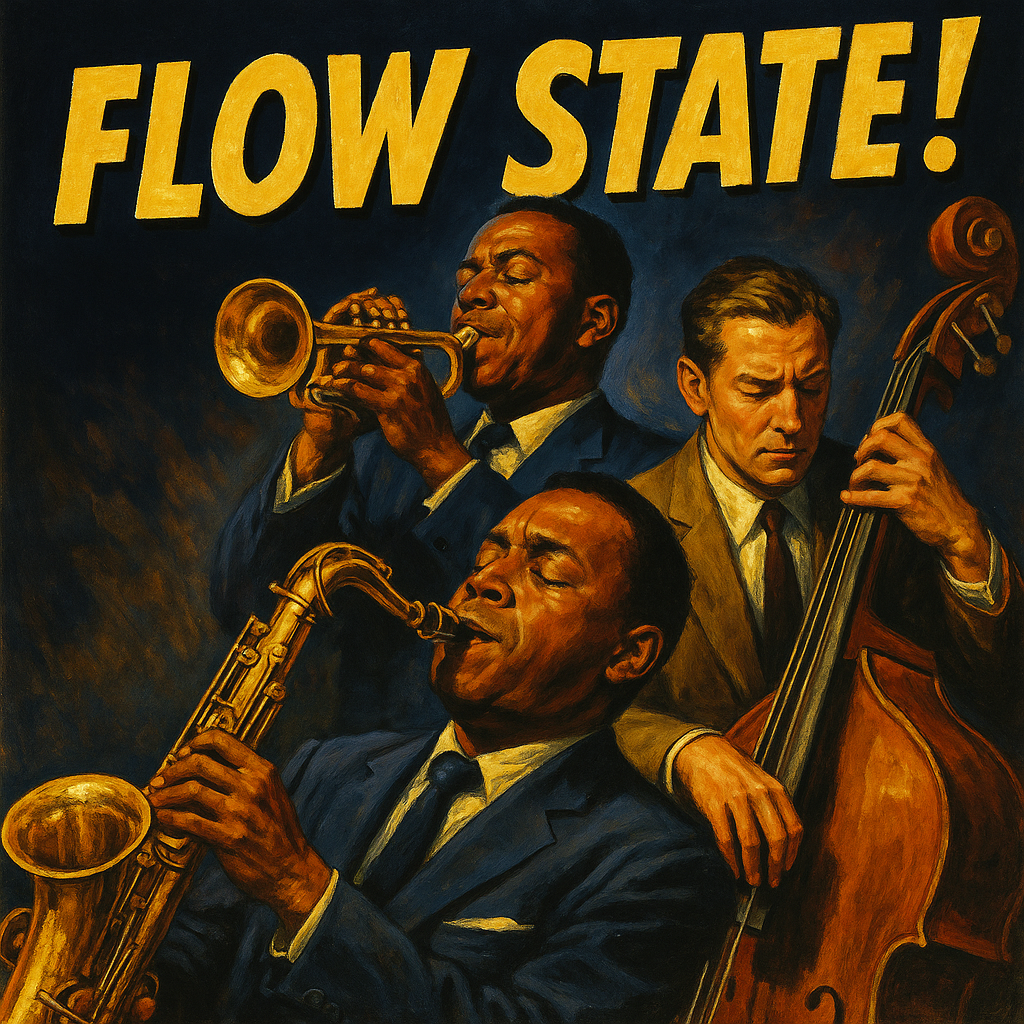


Ask any seasoned musician about their finest moment on stage and you’ll rarely get a story about perfect technique. What you’ll hear instead is something closer to testimony: the night they weren’t playing the music so much as the music was playing them. The solo that seemed to write itself, the phrase that emerged unbidden yet undeniable, the moment they closed their eyes and—somehow—opened a door. That’s the “flow state.” It’s not just performance. It’s a possession of sorts.
Coined by psychologist Mihaly Csikszentmihalyi, flow state is a state of complete absorption, where challenge and skill meet in perfect equilibrium. Time dilates. Ego dissolves. Athletes call it a “runner’s high”—a similar euphoria that arrives when the body and mind sync into something beyond conscious effort. Among runners, it’s often described as the feeling that you are running on clouds. For the improvising musician, this isn’t a theory—it’s an arrival. Notes don’t come from the hands anymore; they come from somewhere deeper, stranger. It’s Coltrane spiraling through a solo that bends light. It’s Bill Evans mid-improvisation, mid-storm, conjuring voicings that seem whispered by ghosts of chords not yet written. It’s Nina Simone’s melodic reckoning, dragging emotion through every note like a cipher only her nervous system understands. It’s the sense that you’re not inventing—that something is being revealed to you, note by note.
Neurologically, studies show decreased activity in the prefrontal cortex during flow state—our inner critic goes quiet. The internal voice that frets over missed notes, bad tone, or the crowd’s indifference gets muted. In its place: pure presence. That doesn’t mean chaos. Quite the opposite. It’s structure without strain, intuition without interruption. A kind of elegant tunnel vision, where every muscle, breath, and instinct is dialed to the same frequency.
Many musicians spend their careers chasing this state, not because it makes them sound better (though it often does), but because it reminds them why they began in the first place. For a moment, music becomes what it was before practice, before ego, before expectations—a current you don’t control, but get to ride. It’s addictive not in the way that the acknowledgment of applause is, but in the way truth is. It feels right. Not correct, not clever—right. Like the universe briefly shrugged off entropy and whispered, “Play.”
What fuels flow state? Preparation, paradoxically. Mastery of your instrument gives your subconscious room to roam. So does trust—in your bandmates, in the moment, in the unknown. But it’s also a form of surrender. Flow state doesn’t come when you try to nail the solo. It comes when you stop trying. When you let go of the need to impress, dominate, or control. The channel opens only when the self gets out of the way.
And when it does, something changes. Flow state reveals something astonishing, even sacred, about being alive. In those rare moments when the music takes over, the boundary between self and sound dissolves—and with it, the border between effort and grace. The fingers seem to remember something the mind never learned. The breath becomes prayer—not rehearsed, but felt. And somewhere behind the eyes, a deeper silence begins to hum. Not absence, but presence. The kind that lives beneath language, beneath memory, beneath all the ways we try to prove we’re here.
And what exactly is it? A neurological trick? A trance state unlocked by rhythm and repetition? Or something else—an aperture in consciousness, a brief possession, a divine prank disguised as muscle memory? No one knows. And maybe that’s the point. Whether it comes from synapses or spirits, the flow state offers a glimpse of something vast and unspeakable—a channel to the infinite, if only for a verse or two. And when it passes, it leaves behind a kind of spiritual euphoria—something that feels mysteriously not your own.
Afterwards, you may not recall exactly what you played. But you’ll remember how it felt: like stepping briefly outside of time. Like being in harmony with something immense and intimate at once. And maybe that’s what keeps musicians coming back—not the thrill of performance, but the glimpse of a world where everything aligns. Where the self softens, and the soul—if such a thing exists—gets to speak in its native tongue.
I don’t know exactly what the ‘Flow State’ is, or where it comes from specifically, and it’s unlikely I ever will—but I do know in the rare and fleeting instances I have experienced it, it is a profound joy … and I wish the world possessed more of it.