
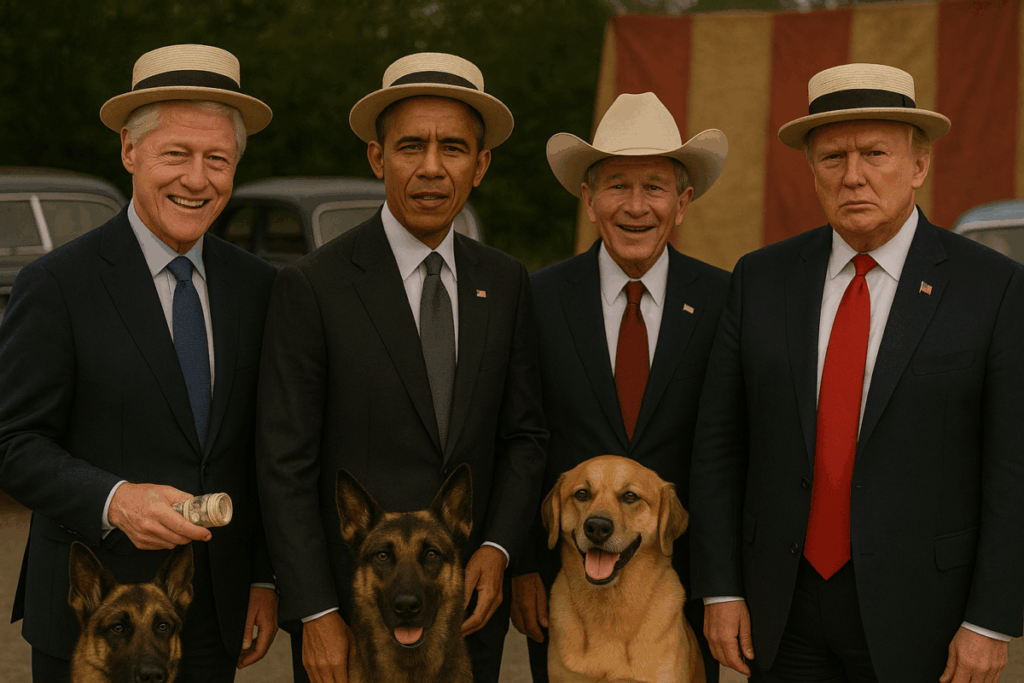


If you want to know whether a presidency will age like fine wine or curdle like a gas station hot dog, skip the polling data and look at the dog.
Since George Washington unleashed his foxhounds across Mount Vernon, presidential dogs have served as moral weathervanes, stress therapy, and the last trustworthy faces inside the West Wing. When the republic wobbles, it’s often a four-legged secretary of vibes who steadies the ship.
FDR’s Scottish Terrier, Fala, became a wartime mascot—a reminder that even as the world burned, someone still needed ear scratches and table scraps. JFK’s Charlie, a Welsh terrier, padded through the Cuban Missile Crisis with the clueless poise of a dog trotting through nuclear brinkmanship like it was a tree-lighting ceremony. Even the PR disasters had canine cameos: Lyndon Johnson, in a move that would have canceled three Instagram careers today, lifted his beagle by the ears—an act of clumsy affection that launched a thousand angry letters and one very awkward press conference.
Dogs don’t spin. They don’t filibuster. They wag or they don’t. In a town that survives on plausible deniability, a mutt gnawing through the Situation Room rug is the last honest broker left in Washington.
Which brings us to the absurd parallel America desperately needs: presidential dogs are to administrations what doomed car brands are to industrial history.
You can spot a failing presidency the way you spot a failing car company: too much polish, not enough drive. Compare Nixon to the DeSoto—a brand so mired in bloat and bad instincts it vaporized in a cloud of chrome and regret. Nixon had Checkers the cocker spaniel, sure—but his real liability wasn’t canine; it was the unraveling trust in his presidency, which limped off the lot with a full tank of paranoia and a trunk full of tapes. He opened China, ended the draft, and signed the EPA into existence, but none of it survived the black hole of Watergate. The Nixon presidency, like a DeSoto in its final years, was built on heavy legacy, sold with a wink, and ultimately abandoned on the roadside when the engine of presidential credibility seized up.
Jimmy Carter brought Grits the border collie mix into the White House, all humble promise and homespun appeal—until the economy tanked and his presidency stalled like a Hudson Super Six left in a Georgia swamp. He brokered the Camp David Accords and installed solar panels on the roof, but the country saw gas lines, inflation, and a hostage crisis—and judged the mileage, not the maintenance. Even Grits, earnest as he was, couldn’t herd public opinion back to the pasture. Carter’s presidency, like the Hudson, was reliable in name but ultimately outdated, underpowered, and no match for the performance expectations of the modern freeway.
Meanwhile, Reagan had Lucky, the Bouvier des Flandres, who was so energetic and oversized he had to be exiled to a California ranch—a metaphor so on-the-nose for Reagan’s two-term cowboy mythos that you couldn’t script it better. Reagan sold optimism like it came in a Mason jar, wrapped in a flag and tax cuts. He ended the Cold War with a smile, deregulated like a man pruning a jungle with a chainsaw, and left deficits ballooning and watchdogs muzzled. Lucky didn’t know it, but he was the canine face of trickle-down charisma. Reagan was a ’57 Chevy—chrome-plated, nostalgia-soaked, and capable of selling the dream even if the suspension was shot.
Millie, George H.W. Bush’s Springer Spaniel, charmed reporters and probably polled better than most cabinet members. Millie did what no political spin could—inject some warmth into a presidency often seen as competent but uninspired. Her presence softened the image of a leader who won the Gulf War with efficiency and poise, but couldn’t steer the country clear of a looming recession—and whose promise of “no new taxes” dissolved into political quicksand the moment the ink dried on a budget deal. Bush governed like someone who still believed the job was about service, not branding—even if that service sometimes included quiet covert wars and a foreign policy stitched together behind closed doors. He kept the public calm and largely uninformed, like a pilot who doesn’t announce the turbulence until after it’s over. His administration was like a Volvo 240—sensible, durable, and a bit too square for an electorate hungry for flash. He was, in many ways, the last of his kind: a president more technocrat than showman, more boardroom than greenroom. What followed was the modern era—part spectacle, part shell game—where performance began to outpace principle, and grift started cosplaying as governance.
Bill Clinton’s chocolate Lab, Buddy, arrived during the height of impeachment drama—a wide-eyed, tongue-lolling reminder that devotion still existed somewhere inside the Beltway. Tragically, Buddy’s days were as short-lived as Clinton’s moral high ground, meeting an untimely end after leaving the security of the yard—a sad metaphor for an administration that never quite managed to stay inside the lines. Between saxophone solos and sexual escapades, Clinton turned the White House into a late-night punchline—equal parts charm and chaos. Yet in a rare act of bipartisan function, his administration balanced the federal budget and briefly made fiscal responsibility seem cool again. Like a late-model Chrysler Sebring, his presidency was sleek on the dealer lot but prone to leaking integrity once the top came down—comfortable, popular, and always just a little too close to the edge of a recall.
George W. Bush, not to be outdone, brought Barney, a Scottish Terrier, into the fold—a dog so regimented and dutiful he could’ve run his own press conferences. While the administration pursued Weapons of Mass Destruction and rolled out nation-building like it was a dealership liquidation sale, Barney patrolled the South Lawn, blissfully unaware that Halliburton was selling lemon-grade wars at Rolls-Royce prices. The weapons, of course, were never found—what once passed as national security now reads like a fictitious pretense to line pockets and expand portfolios. Dick Cheney, with a straight face and a war plan rooted in sweetheart, no‑bid oil contracts, profited from a fear campaign that turned chaos into quarterly earnings—costing thousands of lives while defense contractors gorged at the Pentagon trough. Bush’s presidency was like a mid-2000s Hummer—loud, gas-guzzling, and convinced it could fix the terrain by driving over it.
Barack Obama’s Portuguese Water Dogs, Bo and later Sunny, were less companions than curated symbols—polished mascots for the “hope and change” floor model. Bo radiated calm, the kind that plays well in a press packet. But behind the sheen, the presidency often veered from its promises. Race relations soured, Wall Street flourished, and Main Street got speeches. He vowed to lift the working class while quietly bailing out the architects of its collapse. It was a showroom fantasy—marketed to ease white guilt with a down payment on a redemption dressed in activist trim but running on donor-class fuel. Suburban Karens and yoga-matted hippies, still detoxing from Bush-era disillusionment, lined up for the test drive—buying into Obama like he was a limited-edition hybrid that could cleanse their conscience and their carbon footprint in one smooth ride. The hope was potent, the branding masterful, but when the wheels came off, all that remained were slogans—and two very well-trained dogs.
The initial Trump years were a dogless interregnum—emotionally sterile and loyal to nothing beyond the last headline. No fur, no anchor, no empathy. It was politics without paws: chaotic, combustible, and best handled with oven mitts. Trump governed like a Dodge Charger—divisive, over-torqued, and constantly redlining while the rest of the field fumbled the ignition. Even a rescue mutt, one suspects, would’ve kept its distance—instinctively aware that in Trump’s world, loyalty only moves one way and usually ends with a court date.
Biden’s German Shepherds, meanwhile, didn’t just bark at aides—they seemed to be barking at the slow fade of authority itself. As the president drifted visibly into cognitive fog, the dogs lunged and bit like living alert systems, warning that someone should maybe check who’s actually in charge. In the vacuum, aides and interns jockeyed for the gas pedal while news anchors applauded like sales floor flacks—hoping enthusiasm could cover for the fact that no one was really at the wheel. The wreckage of immigration policy—chaotic, cruel, and clearly micromanaged by staffers—became one more cautionary tale dressed in executive branding. Biden’s presidency is shaping up to be remembered like the Oldsmobile Aurora: styled for gravitas, but encumbered with bad design and features that never quite worked. It still ran—but only because someone else was steering from the passenger seat, right up until it missed the last turn and quietly rolled off a cliff.
In short: the dog tells you everything.
Presidents without dogs end up like cars without brakes—careening into scandals, service issues, and the eventual salvage yard of history. Pontiac, Packard, Plymouth—names that once roared with promise now rust quietly in the American memory, roadside warnings for anyone who thought charisma alone could outrun entropy.
Every presidency comes with its own pack of critics, roadblocks, and headline-grabbing ’emergencies’—often inflated just enough to bruise reputations and boost ratings. But the job isn’t to whimper or wag for approval—it’s to drive forward anyway, even when the road is full of potholes someone else dug.
A presidency, like a car, needs maintenance—more than it needs soft lighting or a primetime slot. And when the buyer is the American public, they’d better start checking under the hood. Ethics and judgment aren’t luxury features—they’re standard equipment, or the whole thing breaks down.
Give me a president who tosses tennis balls on the South Lawn over one who lobs subpoenas from a bunker. Give me a dog—and maybe a Buick that doesn’t leak oil—and I’ll show you a country with fewer breakdowns, and two things in Washington that won’t lie. And for the love of tradition, maybe someone get Trump a dog already—not because he needs companionship, but because the American public needs the illusion of it. Something hypoallergenic, camera-friendly, and cool-headed enough to survive a Fourth of July press gaggle without baring its teeth. Americans love a photo op with fur. It doesn’t matter if the dog bites aides or humps visiting dignitaries—so long as it looks vaguely patriotic in a red, white, and blue bandana, and polls well. Because when the public stops demanding standards and accountability, it settles for pageantry. And nothing sells forgiveness like a golden retriever curled at your feet.
At the end of the day, America doesn’t just need leadership—it needs someone who knows when to heel, when to listen, and when to bite the hand that keeps feeding Wall Street.
So yeah, give me a president with a dog—preferably one that craps on lobbyist lawns, growls at consultants, and reminds us that loyalty should matter more than legacy hires.
And while we’re at it, maybe let’s bring back the Buick too—just so we can all finally agree on one thing:
The country runs better when someone’s riding shotgun who can smell bullshit before it hits the fan.